Children

The Importance of Purple Penguins


By Becky “Duck” Dudley

Recently, a school in Nebraska hit headlines after it made the decision to stop using gender exclusive language, such as ‘girls and boys’. Instead, they’ve opted to use a ‘classroom name’- a term decided by the teacher and/or class to describe the class as a whole. In this case, they used ‘purple penguins’.

It’s an idea that many have ridiculed - particularly due to the term ‘purple penguins’, which is seen as being weird and/or unnecessary. Ho
wever, speaking as a swimming teacher, I think it’s a great idea, and one I am going to implement in my lessons.

It’s not the first gender-related inclusive teaching strategy I have adopted. I do what I would hope is standard in all lessons, and refuse to let the children in my care use gender as an excuse or insult- there are no cries of ‘you’re only a girl!’ or ‘man up!’ in my lessons, not from me and not from the kids. I am trying my best not even to say ‘good girl’ or ‘good boy’.

A few months ago, I went a step further. In the lesson I was teaching at the time, I chose to split the group into two, to play a team game. We had equal numbers of girls and boys, so the children asked to be split into gendered teams. After a moment’s thought, I said no. It’s a principle I’ve continued with ever since - as far as possible, if we are playing a team game, the teams will have mixed genders.

Why these measures? The ‘obvious’ reason is to provide inclusion for any children who already feel that, for whatever reason, they don’t fit into the binary categories gender presents us with. That is, indeed, one of the main reasons for my choices. It would genuinely break my heart if any one of the children I teach felt the language I used excluded them, or if my language choices were adding to their confusion over their own identity.

However, being gender inclusive does not just benefit those who don’t fit into the binary presented to us by society. It benefits all of the children I teach. For example, having such a separation of genders, as summed up by ‘girls and boys’, enforces the idea of irremovable gender-roles. We have the ‘girls’, with their babies and make up and cooking; then we have the ‘boys’, with their cars, sports and DIY. These roles cannot be separated - girls cannot be strong, boys cannot display emotions. This is really harmful, as it prevents people from being who they are, and pigeon-holes them into an identity based around their genitals.

Moreover, all the children I teach are aged between 4-12. In our society, this is a really important age. This is generally the age range where children are socialised to see and conform to the gender split, going from playing indiscriminately to often (though not always) playing in gender split groups. I don’t see this as being a positive at all. In later life, this early isolation leads to the idea of ‘men are from Mars, women are from Venus’, where men and women are seen almost as two separate species. This causes all sorts of problems due to a perceived lack of understanding and empathy between genders. If there had been less separation earlier on, later life - and later relationships - could be far easier to navigate.

As a result, I feel that the schools in Nebraska have a valid point. More than that, I feel that non-gendered language and teaching strategies should be implemented in each and every teaching instance. It’s not going to happen overnight - there will be trial and error. But as anyone who teaches will know, the act of teaching itself is a learning curve. We learn with our children, and if we want the best for them then we must constantly be adapting.

In addition, adopting such an approach is not going to have a massive effect straightaway. However, in the short-term it will make sure that we are including all students, and in the long term it may well help them in later life. Both of these benefits are far too big not to consider, especially when the path to such outcomes is, really, pretty easy. Join me, Nebraska, and plenty of other individuals as we say: ‘Purple penguins, you’ve worked well today. Let’s have a purple penguin high five.’
 

Being an MP is not for me

By Becky Dudley

meninparliament Being an MP is not for me

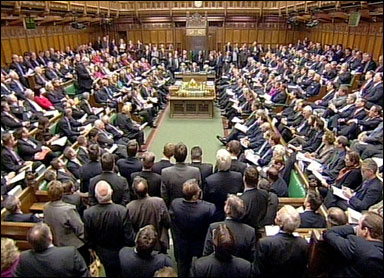
Parliament: it’s a man’s world. To be more specific, it’s a straight, white, middle class man’s world. For something that’s meant to be representing our society as a whole, it’s doing a pretty awful job. What we need, more than anything, is far more people who aren’t straight, white, middle class and male to be in Parliament, representing all those currently lost in the sea of identical faces. However, with the way things stand, I, for one, will not be one of them. Despite wanting to prove a point and do what we’re not ‘meant’ to, I do not want to work in Parliament. I’m here to tell you why.

Firstly, let’s look at some statistics. In the last election, 650 people became Members of Parliament. 147 of these were women. That’s around 23% - hardly representative of the UK population, which is 51% female. The statistics for ethnicity and class are just as bad (if not worse), and each are deserving of their own post; I could rant for hours on any of these. For now, however, I’m going to stick to looking at the statistic for women.

To try and rectify the obvious inequalities, quotas were introduced. To my mind, quotas are like Marmite - you either love them or you hate them. Like Marmite, I’ve not yet decided which side I’m on. However, what the quotas have done is given rise to new terminology - for example, ‘Blair’s Babes’ and ‘Cameron’s Cuties’. Both of these terms - which refer to the group of women working for the relevant Prime Minister - make me feel genuinely sick. They are demoralising, demeaning and downright disgusting. The use of the surname and possessive apostrophe signifies that all the women in these groups belong to the Prime Minister - playing into the ever-present objectification of women. Meanwhile, the use of ‘Babes’ and ‘Cuties’ reduces the women to pretty faces, to sex symbols. These women are all there on their own merit - they are far more deserving than these descriptions make them seem.

This is not the only problem that these women are facing. For women in Parliament, there is no way of being right. When they appear in the media, their clothing and appearance choices are far more likely to be commented on than anything else. There’s a plethora of negative stories, with each female Member of Parliament having faced their own equally awful battles, revolving around sexist comments, unfair media representation, and even discrimination based on their having children - regardless of the fact that men, too, have children and childcare responsibilities.

Even the physical representation inside Parliament is hugely biased. Whilst walking around on a recent tour, we noticed one female statue: that of Margaret Thatcher. We also played a ‘game’ of ‘Spot the Women’ with a painting of the House of Commons in session. It was far harder than the average game of ‘Where’s Wally?’.

But these all come into effect later on, once you’ve gained your votes and got the right to your bum on a seat. There are perils to face beforehand, too. To get in to Parliament, it seems that you must do two things: know the right people, and take up social drinking. Both of these are pretty exclusionary. For a start, how many average members of society have the necessary connections to get them into - or even near - Parliament? A quick survey of the eleven people I am sat with finds that no-one has these connections. Moreover, it follows that if connections are needed, then there’s likely to be a ‘sort’ of person who has them, a theory as close as proven by a look at the current government.

To look at the second option, social drinking, it’s clear that there are fundamental flaws here too. In 2009, it was found that around 15% of people in England are tee-total - they abstain from drinking alcohol, for religious, personal or other reasons. This means that 15% of the population wouldn’t be able to follow this route at all. Even for those who do drink, it’s a pretty dismal concept. What it’s saying is that, to gain a job in Parliament, you must firstly become just like every other person in Parliament. In short, you must become ‘one of the guys’.

With all of this in mind, the only conclusion I can find is one I would much rather not come to: Parliament is unrepresentative, and it’s unrepresentative for a reason. If it’s not hard enough for women to get in in the first place, life gets even harder once they’re there. I take my hat off to each and every woman working in Parliament - I couldn’t do it. It’s no wonder that the statistics are so awful. We need this to change, and we need it urgently. However, this can’t be a small change - every new woman in Parliament is a success for us all, but we need more. We need a huge, drastic change. We need 51% of the Members of Parliament to be women - something that the 50:50 Parliament campaign is currently fighting to achieve. We need to have our statues, our pictures, of women. We need the media to report on what we’re actually doing, not on what we’re wearing or looking like. In short, we have yet more need to start the revolution.