Newspaper

Chalk and Cheer for 44 Years

By Jess Hayden

10405254 835515289844986 8615538126622825027 n Chalk and Cheer for 44 Years

Today marks 44 years since The Sun started having a topless woman on Page 3. This means that, for 44 years, The Sun have sexually objectified women to the point where the easiest way for a woman to be in the newspaper is to stand with her breasts out. What does it teach people – of all genders about women, if the biggest photo of a woman in Britains most popular “family” newspaper is a topless one? It teaches that women exist purely to be looked at.

At No More Page 3, we say this is 44 years too many. So, to mark the anniversary, we decided to protest yesterday outside of The Sun HQ near London Bridge. Chalk in hand, we stormed the square and wrote messages on the floor and walls for The Sun workers to read on Monday morning. Loudly, we sang “shove it up your bum old Rupert Murdoch”, to which The Sun’s security sang along. It was a great day, and PBG editor Yas did a great job talking to the police officers and using her charm to let us continue.

After hours of chalking and singing, we retired to the pub only to see cleaners take to the square to try to remove our artwork. We made it as difficult for them as possible. We lay down on our artwork, stomped our feet and sang as loudly as we possibly could. Soon, the cleaners gave up. Our artwork remained there for editor David Dinsmore and co. to read in the morning.

After all, we do strive to be as big of a nuisance as possible. I think we’re succeeding! Help us out by tweeting using #44YearsTooMany and urging everyone you know to sign the petition at change.org/nomorepage3

B2k2UUuCQAAfVUw Chalk and Cheer for 44 Years

Work Experience at The Sun

folded newspapers Work Experience at The Sun

The author of this piece has asked to be kept anonymous.

It was 8.55am and I was relieved to have arrived at reception with five minutes to spare. I felt feelings of excitement and trepidation; with budding aspirations to be a writer and journalist, securing work experience at the biggest read family newspaper in the country was a massive deal – especially as my previous journalistic endeavours had remained in my local Essex Chronicle. As I smoothed out my newly pressed trouser suit and pinned back my flyaway hairs, I felt the image of professionalism, ready to start my first day of work. The receptionist assured me that a Reporter was on his way to collect me. With that I waited.

Until 10.07am

‘Hello love, sorry for keeping… my Christ, aren’t you a pretty little thing? Can I offer you a drink?’ Considering the fact that I had already had four lattes to pass the time, I thanked him and declined.

As we got into the lift, a series of standard questions ensued. He seemed surprised that I wanted a degree from King’s College London: ‘I doubt a Russell Group university would offer a hairdressing degree,’ but I was quick to correct him that English Literature was my chosen subject. Of course, he didn’t mean it (or that’s what he assured me); I should learn to have a sense of humour rather than being so sensitive, he said.

It was when I admitted that I was born and raised in Essex that his eyes returned to their previous, opportunistic readiness: ‘Wheyyyyy we have an Essex gal in the office? Shame, I expected you to be caked in fake tan and eye lashes. You don’t even sound like you’re from Essex! Regardless, you will fit in perfectly on the Showbiz desk. Rewrite this Cheryl Cole interview in Heat if you will. Make it seem as if we did the interview. Thanks love.’

Simultaneously flustered and disheartened at my position, I asked if I could tour the other departments - a choice that did little to salvage my enthusiasm. Sport seemed full of boisterous footy fans, the News Desk yielded such basic grammar that my own sixteen-year-old intelligence felt insulted and finally… we came to Page 3.

I could not believe my eyes at the room of ‘journalists’ enlarging, shaping, and photo-shopping the topless glamour model photos to portray a picture of sexuality and seduction. I remember thinking for a split second how unusual it was that I could not hear more vulgar, derogatory comments being made about the images – I suppose that if your job was to airbrush and edit a woman’s naked body every day, all day, the novelty wears off in time.

Needless to say, my judgement had been made too soon. Sure enough, a voice hollered: ‘Her tits are bigger than melons’ and ‘Who hired her? Her face looks like a horse. Can we edit out her face?’ My fears had been confirmed.

‘Whose that?’ questioned one of the reporters, turning to me. ‘Just the work experience girl,’ replied my mentor, ‘She’s from Essex you know.’ Why my birthplace was of such amusement continued to baffle me. ‘Wheyyyyy an Essex girl!’ was the unsurprising response as he persisted: ‘Well, I hope you enjoy your time. When you decide it’s time to get a boob job then don’t forget to contact us… just joking love! Got to have some work banter to pass the time in the office!’

BANTER. A JOKE. Of course it was. I should learn to get a sense of humour right? It’s only harmless! That’s when I went to the loo and cried.

It was then and there that it dawned on me. Until that point I had been a naïve sixteen year old believing that sexism was a thing of the past. I now had experienced first-hand that the media is dictated for and consumed by men. We breed a culture that thrives on propelling the view that women are commodities for male entertainment. It was no wonder that The Sun was one of the most widely read newspapers in the country – it was certainly not relying on its grammar or news coverage, but its vulgar headlines and naked women. Why is an image equivalent to those found in ‘lad mags’ available at child’s-eye level? An image that feeds our young boys that this is women’s purpose: to be a man’s play-thing and object. An image that feeds our young girls false ideologies that sex sells and is a wise move if one wants to be successful in a culture of patriarchal hierarchy. As I contemplated these harsh truths, I wanted to shout at my colleagues that these pornographic, derogatory images are not harmless, nor are they just ‘banter’. I wanted to answer back to the room of misogynistic men that I did have a sense of humour, but there is quite frankly nothing hilarious about the exploitation of my gender. These images compound on real women’s wellbeing, safety, behaviour and education. I wanted to question why these ideologies were still prevalent in the 21st Century. I wanted to say all of this, but felt powerless to do so at the age I was.

I finished my work experience in silence and walked out the door vowing never to return. Five years on, nothing has changed: The Sun continues to be produced with the Page 3 image. This is the first time I have spoken about my experience, in hope that someone will listen. If a naked woman’s body can be used as such a vital component to media consumption, it is about time that a woman’s voice should become the vital component to stamp out media sexism. That’s why I am shouting back and supporting the @NoMorePage3 campaign. Its #TimeForChange don’t you think?


To read PBG’s statement of support for the No More Page 3 campaign, click here.

To sign the No More Page 3 petition, click here.

We Support No More Page 3

We support No More Page 3. As an organisation that seeks to empower young women through writing and activism, we feel that Page 3 undermines all the incredible work that young women are doing. We live in a society where young women’s voices have been left to fight for space in a corner on the Internet, but young women’s bodies are readily available for consumption every day in a newspaper. Page 3 has made each of us - at some point - feel uncomfortable, disrespected and powerless. We want women to be represented for what they do rather than what they look like. We want to live in a society where young women’s words hold more importance than the shape and size of our breasts.

Page 3 is an unnecessary part of The Sun that does little to increase sales (if anything it decreases them) as well as causing many people, including myself, to feel uncomfortable. What does it add to the newspaper? Surely it cannot be considered to be news? And the amount of occasions where it is blatantly out of place such as after headlines about child abuse or rape! It is wrong and must go. – Chloe, 18

A newspaper is widely considered a household item, part of everyday life. Therefore, Page 3 makes naked women seem like part of everyday life, too. As a result, it becomes ingrained into people from a young age that this is normal and expected; women bare their breasts for men, and that is the end of it. This is hugely damaging in many ways- for example, it can lead to pressure if a woman doesn’t want to do what a man wants, and it gives a false image on both sides as to what the female body should and should not look like. These negativities should not be such an accepted part of life. It’s time to move on- it’s time to get rid of Page 3. – Becky, 17

Seeing women presented as sexual objects alongside men presented as politicians, high achievers and world leaders has a massive effect on how society sees women, particularly young girls, who begin to believe a woman’s only purpose is as a sexual object. Page 3 perpetuates this belief and is also hugely detrimental to the self-esteem of girls and young women. Page 3 is an archaic practice that is holding back our society from erasing sexism. – Amy, 16

The Sun is supposed to be a family newspaper. But no families I know buy it. Why? Because they don’t want their children to learn that sexualisation of a woman is normal. That women are just their bodies, simply objects. Page 3 is disgusting misogyny, and it doesn’t do much for The Sun’s sales anymore, so why have it? – Sophia, 17

I support NMP3 because the idea of women’s breasts being entertainment in a newspaper perpetuates the idea that women are there to entertain men. Glamour modelling has no place in a newspaper and quite simply, boobs aren’t news. – Jess, 16

I support NMP3 because every time I feel like society is making a little step further towards an England where women aren’t sexual objects, I’m reminded that Page 3 exists and all hope is lost. It’s shocking and like a sharp kick to the stomach. Whilst some may feel this ‘news’ is harmless, I can promise you, it isn’t. 1 in 5 women will experience some form of sexual violence In England and Wales, and I, as well as many others, believe that the day Page 3 doesn’t exist will be the day people will begin to view women more as human beings that deserve respect, not sexual toys to provoke and abuse. I support NMP3 because I don’t want to live in a world where people are so ready to critique a woman for presenting her body sexually in public, yet believe it’s okay when the Sun does the exact same thing for profit. If the exploitation of women’s breasts for profit is ‘just the way it is’ then I’m scared to be a woman, and that shouldn’t be okay. – Gemma, 18

The convention on the Elimination of All Forms of Discrimination against Women dictates that states must ‘take all appropriate measures to eliminate discrimination against women by any person, organisation or enterprise’. Factually speaking, the UK government partakes in this movement; a fact that seems almost laughable considering the complete lack of enforcement when it comes to women in the media. I wish to question as to why the shocking discrimination against women perpetuated by Page 3 continues to thrive and prosper on newspaper stands and shelves. Why is an image equivalent to those found in ‘lad mags’ available at child’s-eye level? If the government’s own research has shown a link between the portrayal of women as sex objects in the media and greater acceptance of sexual harassment and violence against women, why does the government refuse to ban Page 3? The answer, ashamedly, is that we live in a society where the media is written by men for men; a culture that propels and perpetuates the view that women are commodities for male consumption and entertainment. I contend that these pornographic, derogatory images are not harmless, nor are they just ‘banter’. They compound on real women’s wellbeing, safety, behavior and education. They are feeding our young boys that this is the purpose of women; this is how young women should be viewed, used, abused, exploited and treated. They are feeding our young girls the notion that sex sells and is the only solution to achieving success in a male-dominated world. Why are these ideologies still prevalent in 2014? If a naked woman’s body can be used as such a vital component to media consumption, it is about time that a woman’s voice can become the vital component to eradicate the former. – Olivia, 21

Please sign the petition: change.org/nomorepage3

For more information about the campaign, visit their website, nomorepage3.org

Cabinet Reshuffle, Same Sexism

By Jessica Hayden

dailyfail2 Cabinet Reshuffle, Same Sexism

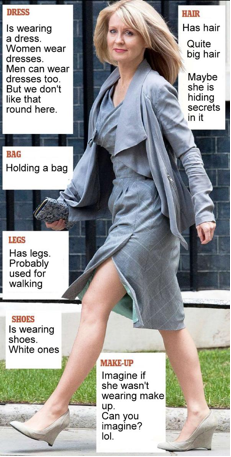
The cabinet reshuffle promised to be a great day for women in politics. Women were promoted, such as now Minister of State for Employment, Esther McVey. Campaigns such as 50/50 parliament - which seek for a more equal male/female number of MPs - rejoiced at the news that the future may hold a cabinet that isn’t exclusively male and “fat, balding Tory, Home Counties, upper-middle class twits ” as Bridget Jones so wonderfully puts it.

However the media’s response to what was supposed to be a triumph for women was disgustingly sexist, to say the very least. The words “child care” and “school run” were used too often when talking about how on earth the women could possibly handle being politicians and also juggle their “mothering responsibilities”. Of course no reference was made to David Cameron’s ability to juggle being a father of three and being Prime Minister, despite him forgetting how many children he has and leaving one in a pub toilet back in 2012. The idea that a woman should focus only on their children and not have a career belittles women and encourages the belief that women should only ever be stay-at-home mums, which is dangerously old-fashioned in a “modern” society.

The Daily Mail, as always, did their absolute best to patronize and insult women, calling the reshuffle a “catwalk”, describing Esther McVey as “The Queen of the Downing Street Catwalk” and a “thigh flashing vision”. Once again, The Daily Mail cared more about what women look like than what talents they may have. The Mail went as far to say “She needs to tone it down a little for attending Cabinet meetings.” As her “bust-emphasising” dress was just too much for the paper, which homes the infamous “side-bar of shame” which tells women they are too fat, too thin, show too much skin but not nearly enough skin, all at the same time. Women are never going to be respected in The Mail, but this article still infuriated me, feminists all around… and Nick Clegg, apparently.

Clegg responded to The Daily Mail article, saying he thinks “it’s demeaning, old-fashioned and most people would just think it’s completely out-of-step with modern Britain.” It’s brilliant that a recognised man in politics has noticed the blatant sexism of the media. However some of his comments, such as it being “out-of-step with modern Britain” were ambitious.

Unfortunately, this attitude to women in politics IS modern Britain and more needs to be done to establish women in politics and present them in a fairer way, like discussing their jobs, rather than their skirt-length.

dailyfail1 Cabinet Reshuffle, Same Sexism

Breast Amnesia

By Jessica Hayden

Breast Amnesia - forgetting that breasts are actually there to feed children and aren’t necessarily there solely for sexual pleasure…

How many of us suffer from this?

I recently read an article online about Ashley Clawson, a woman who was refused to breastfeed in Victoria Secret, a lingerie shop. My first reaction was wondering how I would respond if someone asked me if they could breastfeed in my hypothetical shop. I decided that the best solution would be to say yes, of course, and perhaps offer a more private area, purely for their comfort rather than my opinion on public breastfeeding. Then I considered why breastfeeding is encouraged to be such a private act whereas sexualising breasts is such a public act. You not only see women in their underwear in adverts and on the sides of buses, but breasts appear almost daily in your “family” newspaper. I started reading what other people thought and the response shocked me. The vast amount of replies were calling breastfeeding in public “wrong” and “embarrassing”. However, there was one woman’s response which left me completely baffled. She called breastfeeding in public “inappropriate”.

What kind of culture teaches that breastfeeding is inappropriate? How is it that our society has evolved in to one which calls a pair of sexualised breasts in a newspaper “tradition”, and vilifies anyone who dares protest against it (which has certainly been my experience when campaigning for No More Page Three, a campaign which seeks to remove glamour modelling from The Sun, a so-called “family newspaper” which has a page dedicated to sexualising women) yet dismisses a woman for having her breasts out in public in order to feed her child - which, let’s remember, is what her breasts are meant to do! Victoria Secret, far from celebrating women’s bodies, as they would so have you believe, have illuminated the cold misogyny which I have named “breast amnesia”.

If breast amnesia isn’t a sign of how our society is reducing women to being purely sexual beings, then I don’t know what is. It’s time we started discussing it.

Porn in the Paper: News Not Boobs Please!

3 300x110 Porn in the Paper: News Not Boobs Please!

There’s this wacky thing in Britain where people think it’s ok to have soft porn on the third page of a family newspaper. Yas Necati, of the No More Page 3 campaign, discusses Page 3, it’s problems and why 43 years is about time to see the end of this sexist and embarrassing institution.

What is it?

Back in the 1970s, when sexism was still so extreme that a woman couldn’t even buy her own property, two newspapers decided to start printing pictures of women in nothing but their knickers. One of them* dropped this idea in the next decade because they realised it was sexist, degrading and out of place. The other decided to just carry on, and does so to this day. Apparently it’s all just a bit of “harmless fun.”

This might all sound a little bit nonsensical, but I’m not making it up! This is the reality in Britain, where our biggest selling ‘family news’paper has just celebrated 43 years of selling topless images alongside the sport, celebrity gossip and updates about the royal baby…

Where?

The name of the newspaper is the Sun… in terms of pathetic fallacy it’s rather ironic, if you think about it! The images pretty much always feature on the third Page in – bit tricky if you’re looking to check the weather (page 2) and want to avoid the lady with her breasts out the next page over. Occasionally the image moves back a few pages to make way for a news-feature (generally to do with men), but it’s pretty much always there even if it’s behind a little!

Who?

Page 3 features glamour models. Unpredictably, they represent a binary and stereotypical ideal of beauty. All models are between UK sizes 8 and 10. Their average cup-size is a D/DD. 87.5% of them are white. None of them are male.

When?

The bare-breasted images appear every day of the week, apart from the weekends when the models wear bras… because, obviously, it is impossible for children to see the newspaper on weekdays.

Why?

Good question (we’re pretty baffled ourselves!). According to previous editor, Dominic Mohan, Page 3 is a “British institution” that represents “youth and freshness.” The current editor believes that there’s more raunchy content at museums… seriously! Maybe the real reason is that some people are just afraid of a world where women are actually treated with respect.

How?!

How on earth is this still happening?! Exactly the question actress and writer Lucy-Anne Holmes was pondering one day… she even lost sleep over it! So she decided to do something and start a campaign. No More Page 3. We’re pretty rad.

The No More Page 3 Campaign

During the 2012 Olympics, the biggest image of a woman in Britain’s biggest-selling family newspaper was a topless one. It was even bigger than the picture of Jessica Ennis, who had just won a gold medal for the country. This preached one unfortunate and despairing message: as a woman in Britain, what you look like is more important than what you do.

Lucy became upset by this and decided to start a campaign. A year and 125, 710 signatures later, we’re fighting stronger than ever. With the support of UNISON, NUT and the Girl Guides, as well as over 50% of female MPs, we’re not backing down. We’re a group of 18 volunteers, but a network of thousands of women and men who are fed up and have had enough. The Welsh Assembly support the campaign and the Irish Sun have dropped Page 3… it’s only a matter of time before Britain will follow…

protest 300x136 Porn in the Paper: News Not Boobs Please!

Protestors on Page 3′s 43rd anniversary

*The Daily Mirror

change.org/nomorepage3