Looking for Something?
Posts Tagged for

Photoshop

Heads They Win, Tails You Lose

Author:

By Elli Wilson

Ladies, I have some not-so-shocking news for y’all; in the eyes of our largely sexist and often misogynistic mainstream media, you can never win. Some of you have no doubt already reached this conclusion but it took me almost 18 years to come to the realisation that no matter how long I spend trying to ‘fix’ myself, there will always be another ‘problem area’ which is just crying out for a good wax/work out/cellulite-reducing massage (delete as appropriate). I now know that I can never look like the models in the hyper-sexualised adverts that have become the wallpaper to our lives because they are so heavily photoshopped and airbrushed that they don’t even look like themselves. I’m also aware that if I dare to be successful, I will receive less media coverage than men and if I do receive any it is far more likely to be negative and/or focused on my appearance. Yep, in 21st century Britain the representation and portrayal of women in the media still isn’t looking too great.

We live in a society in which the media is incredibly hostile to women, their bodies and their achievements. Nothing we do is ever good enough. We are either too pretty, too ugly, too thin, too fat, too successful, too unsuccessful, too career-oriented, too family-oriented, too prudish, too slutty, too uptight or too slobby. This list could pretty much continue ad nauseam. Whenever a women is in the public eye you can bet your bottom dollar that she will receive gendered comments about her appearance, her family or lack thereof, and her credibility that no man ever would. Think of the ridiculous commentary about whether Hilary Clinton can be both a presidential candidate and a grandmother, or the way Jennifer Aniston has often been depicted as sad and lonely since her relationship with Brad Pitt ended. And such treatment is not just reserved for individual women but for our entire gender. The behaviour of girls and women is frequently blamed for all manner of ills, from badly behaved children to the perceived crisis of masculinity. The media doesn’t just criticise and belittle us; it also polices our behaviour.

So let us be clear; media sexism is real and it has real consequences. The media’s obsession with women’s appearance - from Page 3 to talk of female politicians’ clothing - tells us that our looks are our most valuable asset. The way that certain newspapers talk about rape victims perpetuates our victim blaming culture where the victim is often held as accountable as the perpetrator. The near total lack of representation of women of colour, disabled women and LGBTQ+ women is a travesty that furthers the restrictive heteronormative, white nature of the society in which we live. As a woman, the mainstream media does not represent me or treat me with respect.

In fact, the mainstream media doesn’t represent or respect many people at all apart from a gilded elite who happen to be largely wealthy, white, heterosexual cisgendered men. This is a total joke and something that I hope the people-powered, accessible nature of the Internet can start to address. Online initiatives such as this one and the hundreds of others like it are working to redress the bias and underrepresentation of traditional media. It’s high time to make a change. If you don’t like what you see, do something about it; our voices and our words are powerful and we can make a difference.

Beauty is in the Eye of the…Media?

Author:

By Guest Blogger Aimee Polimeno


lupita-lightened

People Magazine’s Epic Photoshop Fail of Lupita Nyong’o

It’s no secret that our media-driven culture values an extremely narrow and stereotypical version of beauty, usually represented by a Size 2, photoshopped model. Most people know that judging and media photoshopping any girl larger than a size 4 has a detrimental impact on girls’ body image, and so it’s an issue fought by activists on many fronts. However, what many of us tend to overlook is that our culturally biased ideal of beauty does not encompass only body size, but also race.

The lack of models of various races and ethnicities in media, not to even mention the tendency to photoshop lighter skin tones on those few models and artists who do make the covers of magazines, is one thing. The association in movies and TV between violence and skin color is another. We teach children that when race is visible at all, light is right and everything else is…well, wrong. Consider seemingly harmless animated films like The Lion King, where our main man Mufasa and his family are a lighter fur color, while the evil and calculating Scar is a darker shade. Think about all those dark-skinned evil queens in Disney films.

Multiple studies have been done in psychology and sociology dealing with this early priming of children to favor light over dark, and the results are heartbreaking. A recent study conducted with young children in Mexico featuring a white doll and a black doll found the same results as a famous U.S. study conducted in the 1930’s by Kenneth and Mamie Clark. “Which doll is good?” the children were asked. “Which doll is bad?” “Which doll is ugly?” Almost all of the children associate positive words like “good” and “pretty” with the white doll and words like “bad” and “ugly” with the darker skinned doll. When asked why they like the white doll better, the children aren’t entirely sure; they just know that it’s the better doll. And here’s the heart-breaking part: when asked which doll looks most like them, the children struggle, knowing they have darker skin too, knowing that choosing the darker skin doll forces them to associate themselves with being bad and ugly.

These children are not born with a preference for lighter skin and the lighter dolls; this value has been forced on them unknowingly by the images they see and the stories they are told. This damaging set of values is deeply rooted in our culture and media and, as a result, we as consumers support and perpetuate the problem. There are entire shelves in drugstores dedicated to skin-lightening creams and hair relaxants, but these would not exist without significant demand. It’s difficult to be a critical consumer when we’re constantly barraged by images and ads telling us how we should look and what it means to be beautiful. But the fight has to begin with each one of us.

SS-Shirley

Shirley sings “I Love My Hair!”

There are some positive signs of change. In 2010, Sesame Street featured Shirley, an African-American puppet girl singing about all the reasons “I Love My Hair.” With over 5 million views to date, it’s clear how important (and rare) it is for young African-American girls to see a character representing them who believes her untreated hair is fun and gorgeous on its own.

Shirley and her message of self-love and acceptance became a sensation and an inspiration for young Black girls. If one puppet can make such an impact, why can’t we as a collective group follow Shirley’s lead? It starts with challenging what we are sold in the media and then looking in the mirror and within ourselves to realize that we are beautiful. I am beautiful, and you are beautiful. Together we can push back against the cookie-cutter image portrayed in our media so young girls of all shapes, sizes, and ethnicities can open a magazine and see a beautiful women who look like them. Like Shirley, love your hair, but also love your eyes, your curves, and your mind, and let the world hear it.

The Ugly Reality About Beauty Standards

Author:

By Guest Blogger Maddie Wadington

before-after-fat-model-edited-on-photoshop-2-by-Scarione-b

If you’ve been reading Time Magazine, The Guardian, Glamour, or just about any popular magazine or newspaper of late, you’ve seen reports of a new study that compares men and women’s perceptions of beauty. The researchers asked both men and women to judge which photo of a model, wearing various amounts of makeup, was the most attractive to them, which photo would be the most attractive to other men, and which photo would be the most attractive to other women. Both men and women believed that the models wearing more makeup would be judged as more attractive by men. Interestingly, that wasn’t the case. Results showed that more women than men preferred the model wearing more makeup.

So what’s going on here? The researchers conclude that women are holding themselves to a standard of beauty that does not exist. Well, yes, that sounds right. But in spite of their findings, these researchers assume this standard of beauty is created and maintained solely by men, reflecting their version of attractiveness. This doesn’t make sense to me. We’re bombarded 24-7 with photoshopped beauty ideals, so doesn’t media play an overwhelmingly large role, not only in the creation of this “make believe” version of beauty but also in maintaining this standard in girls’ and women’s everyday lives?

Sure, maybe there are more men making decisions about what images are created and sold, but are they doing this because of what they individually like or because they know what sells to women—what makes women anxious enough to say, “I want what she’s having?” Isn’t the bottom line all about marketing and money and grabbing women’s attention (and as we’ve seen from the likes of Veet’s recent ad campaign, anything goes). Isn’t the corporate bottom line and not individual male desire responsible for perpetuating these unrealistic beauty standards?

It is also interesting to note that the Time Magazine article that I read about this study was titled: “Science Shows Men Like Women With Less Makeup.” But I have to wonder, why is the emphasis placed on how men prefer women? What about considering how women view other women? From my experience, girls and women compare their own beauty to that of other girls and women (just like girls and women do in the media). Could the results of this study-women preferring the model with more makeup—simply be due to the pressures they feel to look like the models they see in magazines?

When we think about how males and females perceive beauty, it’s important to consider more than just the physical attractiveness between men and women. In our society, there are so many more factors affecting what we think of as attractive: like media, marketing, and the ways they impact our views of each other. This isn’t just about gender or even about biology. Only when we consider the larger forces at play here can we affect how these unrealistic beauty standards affect our relationships and how we feel about ourselves. Only then can our voices can be heard.


Three Cheers for Aerie

Author:

images-1

By Kara Chyung

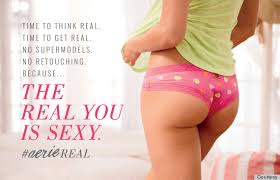
Aerie, the lingerie and apparel branch of American Eagle, has recently announced their “Aerie Real” campaign, promising no retouching and “no supermodels.”

Their recent ads, which echo Dove’s Real Beauty campaign and Seventeen’s Body Peace petition, claim that it’s time to be real, because “The real you is sexy.”

Aerie models are saying that while it’s nice to have Photoshop to hide minor imperfections, the Aerie campaign showed them that they really don’t need the retouching.

images

Some people wonder whether this campaign is necessary, questioning how much girls are actually influenced by the images in ads. But I’m glad that more and more brands seek to make girls feel good about themselves by breaking down the image of an idealistic body. In a country where so many young girls suffer from eating disorders, it’s about time companies are publicly addressing the body image issue. Hopefully Aerie’s decision to eliminate Photoshop will help to create change in the rest of the industry.

Hey there!

We are Powered By Girl. We're young women who write for young women. We do it because we're fed up of media sexism, racism, transphobia and discrimination in all its forms. We create the alternative content that we want to see. Please have a look at our stuff, and join us!

Sign up to get our blogs in your inbox!